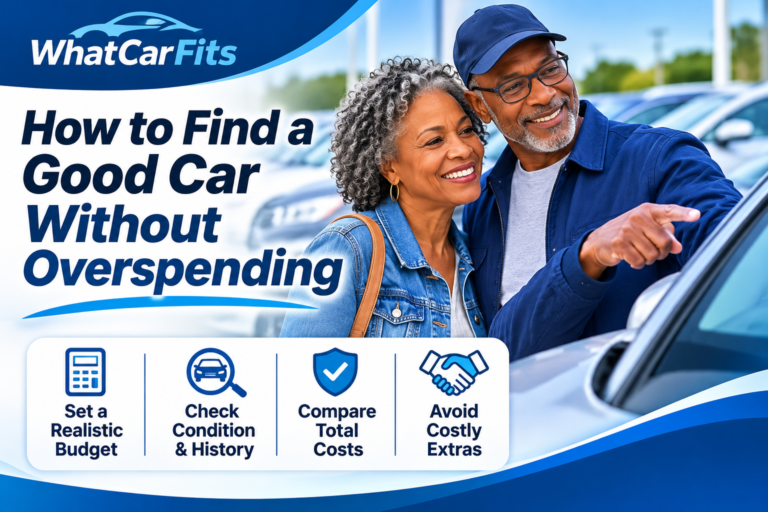
Best Budget Cars: How to Find a Car That Fits Your Monthly Payment
Finding the best budget car is not simply a matter of sorting vehicles from cheapest to most expensive. A car with a low sticker price can still become expensive once financing, insurance, fuel, maintenance, taxes, and fees are added.
A better question is: Which car fits the amount you actually want to spend each month?
That is where budget-first car shopping becomes useful. Instead of choosing a vehicle first and then trying to make the payment work, start with the monthly payment you are comfortable carrying. From there, you can narrow the search to vehicles that make sense for your financial range.
Current budget-car lists include everything from older used sedans and SUVs to newer compact cars. Cars.com, for example, currently groups budget vehicles into price ranges under $20,000, $15,000, and $10,000 rather than treating “budget” as one fixed price.
What Is a Budget Car?
A budget car is not necessarily the cheapest vehicle you can find.
For one driver, a $12,000 used sedan may be the right choice. Someone else may be more comfortable spending $22,000 on a newer vehicle with lower mileage and a longer expected ownership period.
What matters is whether the car fits your complete financial picture.
That includes:
- Purchase price
- Monthly payment
- Down payment
- Interest rate
- Loan length
- Insurance
- Fuel or electricity
- Maintenance and repairs
A lower purchase price helps, but it does not automatically make a vehicle affordable.
Start With the Monthly Payment You Want
Many people shop backward.
They find a car they like, sit down with the dealer, and then ask what monthly payment can be created around it.
That can make it easy to focus on the payment while overlooking how much the vehicle actually costs.
A longer loan term, for example, can lower the monthly payment without making the vehicle cheaper.
WhatCarFits takes the opposite approach.
Start by deciding what monthly payment feels comfortable to you. Then consider your down payment, trade-in value, credit score, financing term, and vehicle preferences.
From those numbers, you can estimate the vehicle price range worth shopping.
Use the What Car Can I Afford? calculator if you want to start with your payment rather than a specific vehicle.
A $400 Budget Is Different From a $600 Budget
There is no single list of “best budget cars” because the right vehicles change as the monthly budget changes.
Someone targeting roughly $350 to $400 per month may need to concentrate heavily on used vehicles, larger down payments, or lower-priced sedans.
At $500 or $600 per month, the range of possible vehicles may expand substantially.
Credit and loan term matter too.
Two shoppers looking at the same $24,000 vehicle can receive very different financing costs depending on their rates and terms. That is why WhatCarFits separates the vehicle price from the estimated payment.
Used Cars Can Open More Options
Used vehicles are often a natural place to look when keeping the purchase price down.
Current budget-car research includes used vehicles such as older Honda CR-Vs, Toyota RAV4s, Honda Civics, Hyundai Sonatas, Toyota Priuses, and similar vehicles across several price bands.
But buying used requires more than finding the lowest asking price.
A less expensive vehicle with deferred maintenance, worn tires, accident damage, or mechanical problems can become costly very quickly.
Before buying a used vehicle, pay attention to its maintenance history, mileage, title history, condition, and inspection results.
A pre-purchase inspection from a qualified mechanic can be especially useful when buying an older vehicle.
Don’t Ignore New Budget Cars
New cars are more expensive than many used alternatives, but some shoppers may still find a new compact car or small crossover fits their budget.
The advantages can include a full factory warranty, predictable maintenance during the first years of ownership, lower mileage, and potentially different financing incentives.
The downside is obvious: you are usually paying more upfront.
The key is not deciding that new is always better or used is always better. Compare both against the same budget.
That is why WhatCarFits allows shoppers to think in terms of New, Used, or Either rather than forcing the decision before the numbers have been considered.
Best Budget Sedans
Sedans remain worth considering for budget-conscious shoppers because they often provide good fuel economy and lower purchase prices than similarly equipped SUVs.
Models commonly found in the affordable compact and midsize market include vehicles such as:
- Toyota Corolla
- Toyota Camry
- Honda Civic
- Hyundai Elantra
- Nissan Sentra
- Hyundai Sonata
- Volkswagen Jetta
The exact model year that fits your budget will depend heavily on whether you are shopping new or used.
For example, a newer Corolla may compete against an older Camry at a similar price. One offers newer technology and potentially lower mileage, while the other gives you a larger vehicle.
Neither is automatically the better budget car.
Best Budget SUVs
SUVs remain extremely popular, but shoppers usually pay more for the added cargo space and higher seating position.
If your budget allows an SUV, the used market can expand the number of possibilities considerably.
Budget-oriented searches frequently surface vehicles such as:
- Honda CR-V
- Toyota RAV4
- Chevrolet Trax
- Nissan Rogue
- Mazda CX-30
- Hyundai Kona
- Kia Seltos
Cars.com currently includes used CR-V and RAV4 examples in its under-$20,000 budget-car coverage, while its lower-priced new-SUV coverage includes several subcompact crossovers.
The important comparison is not simply sedan versus SUV. It is what you are receiving for the additional monthly and ownership cost.
What About Budget Trucks?
Trucks are harder to fit into a tight budget because purchase prices can rise quickly.
Used midsize or compact trucks may be more realistic than a new full-size pickup for someone focused primarily on affordability.
The Ford Maverick is one example of the type of smaller pickup that can appear in budget-conscious searches, particularly in the used market.
However, trucks can also introduce higher fuel, tire, insurance, and maintenance costs.
If you need a truck for work or regular towing, those costs may be justified. If you simply like trucks, compare the complete ownership cost against an SUV or sedan before deciding.
Hybrids and EVs Can Be Budget Cars Too
A hybrid or electric vehicle should not automatically be excluded from a budget search.
Used EV prices can sometimes create interesting opportunities, and hybrids may reduce fuel consumption for drivers who cover substantial mileage.
The purchase price is only one part of the equation.
For an EV, consider charging access, battery condition, range, insurance, and how the vehicle will actually be used.
For a hybrid, compare the price premium with expected fuel savings and the length of time you expect to keep the car.
The lowest fuel bill does not necessarily equal the lowest total ownership cost.
How Much Should You Put Down?
A larger down payment can reduce the amount financed and may lower the monthly payment.
But putting every available dollar into a vehicle can leave you without enough emergency savings.
There is no universal down payment amount that works for everyone.
Instead, compare scenarios.
For example, see what your estimated payment looks like with:
- $1,000 down
- $3,000 down
- $5,000 down
- A trade-in
- No trade-in
This can show whether adding more cash meaningfully changes the vehicles within reach.
Your Credit Score Can Change the Cars That Fit
Your credit score does not determine whether a particular car is good or bad.
It can, however, affect the financing cost.
A higher APR means more of each payment goes toward interest rather than vehicle principal. That can reduce the vehicle price that fits within the same monthly-payment target.
That is why two people targeting $450 per month may receive very different affordability ranges.
WhatCarFits uses the credit score you enter only as part of the planning estimate. Entering a score into the calculator is not a credit application and does not itself perform a credit inquiry.
Watch Out for Long Loan Terms
A long loan term can make an expensive car look affordable.
Suppose a vehicle is outside your preferred payment on a 60-month loan. Extending the loan to 72 or 84 months may bring the payment down.
But you are still buying the more expensive vehicle.
You may also pay interest for longer and remain in debt on the car for more years.
When comparing budget cars, look at both the monthly payment and the loan term producing that payment.
A $475 payment for 48 months is very different from a $475 payment for 84 months.
Cheapest Does Not Always Mean Best Value
There is an important difference between cheap and good value.
A very inexpensive vehicle can be a good decision when it is mechanically sound and meets your needs.
But a low price can also hide costs.
Think about:
- Upcoming tires
- Brakes
- Major scheduled maintenance
- Insurance
- Fuel economy
- Reliability
- Registration
- Repairs
- Resale value
A $10,000 car requiring $3,000 of immediate work may not be a better value than a well-maintained $13,000 alternative.
The cheapest vehicle to purchase can therefore be different from the cheapest vehicle to own.
Cash vs. Financing
If two identical vehicles have the same purchase price, paying cash avoids loan interest. Consumer-oriented buying guides commonly note that this can reduce the financing cost of the purchase.
But that does not automatically mean every shopper should empty savings to avoid financing.
Cash reserves have value too.
Someone with enough money to purchase a car outright may still decide that keeping an emergency fund is more important than eliminating every dollar of interest.
If you finance, compare the total borrowing cost rather than shopping solely by monthly payment.
How to Find the Best Budget Car for You
Start with your finances before opening dozens of vehicle listings.
Decide:
- The monthly payment you are comfortable with.
- How much you can reasonably put down.
- Whether you have a trade-in.
- The loan term you are willing to accept.
- Whether you prefer new, used, or either.
- Which vehicle types actually meet your needs.
Then calculate your approximate vehicle range.
Only after that should you start narrowing the actual cars.
This prevents a common problem: falling in love with a vehicle first and trying to force your budget around it afterward.
Don’t Shop by Monthly Payment Alone
Your monthly target is an excellent starting point, but it should not become the only number you consider.
Before buying, look at:
Vehicle price. What are you actually paying for the car?
APR. How expensive is the financing?
Loan term. How many years will you be making payments?
Amount financed. How much debt are you taking on after your down payment and trade-in?
Total interest. How much does borrowing add to the vehicle cost?
Ownership costs. Can you comfortably handle insurance, fuel, maintenance, and repairs after making the payment?
These numbers provide a much clearer view than payment alone.
The Best Budget Car Is the One That Fits Your Budget
There is no single car that deserves to be called the best budget car for everyone.
A used Corolla might be perfect for one shopper. Another may need the cargo room of a CR-V. Someone with a longer commute may prefer a hybrid, while another driver genuinely needs a truck.
The useful question is not:
What is the cheapest car?
It is:
What car gives me what I need without pushing my budget farther than I want it to go?
That is exactly what WhatCarFits is designed to help you figure out.
Start with the monthly payment you want, add your down payment, credit score, financing term, trade-in, and vehicle preferences, and see what price range may fit before you begin chasing listings.
Then shop the cars—not the payment.